This week we concluded our study of World War II battles by looking at the Pacific and European battlefronts. We watched a clip from Band of Brothers that included interviews with actual members of Easy Company. Their reflections add a sense of humanity to the study of D-Day. How does one prepare to jump out of airplanes that are under constant fire over enemy-held territory? After two years of training, these men knew their mission and were focused on wiping out the German batteries so the troops landing on the beaches of Normandy would have a chance of surviving to start the push to liberate Europe.
We also looked at a power point on the last days of Pacific fighting prior to dropping the bomb. President Truman took over after the death of FDR in April and only 4 months later he had the heavy decision as to how and when to use the bomb. On August 6 the first bomb was dropped on Hiroshima. The Japanese continued to fight so a second bomb was dropped on Nagasaki. The overwhelming destruction of the bombs convinced the Emperor that the time had come to surrender. Should the bomb have been used? Some historians argue that Japan was in its final weeks of having the ability to wage war and the US could have just waited for the surrender. Some historians argue that the Japanese would never give in and in order to save lives on both sides, the bomb must be used.
This week we also had an announced quiz on the experiences of different groups on the battlefront and the dropping of the bomb. Many of you earned high scores…congratulations. Close reading of the text, taking notes, and reviewing all help when it comes time to take a quiz.
We then started our discussion of life on the home front. We talked about how wars are financed: debt, taxes, reducing other expenditures, or printing more money. As you could see from our reading and the handouts, World War II was a massive effort and required the use of all four methods. Military outlays for WW II were almost 40% of the country’s GDP! Everyone at home was effected by the war…food was rationed, gas, oil and tires were limited, and collection drives for scrap metal and rubber were held regularly. There was something for everyone to do to help the cause. With a strong economy focused on producing military goods, workers had money in their pockets. While consumer goods were limited, money was spent on entertainment, such as attending weekly movies and purchasing paperback books known as “pocket” books. After looking at the changes on the home front, we compared changes today as our country is involved in conflicts in Iraq, Afghanistan and now Libya. You had the opportunity to think about our current home front and how our lives have changed or not changed due to these conflicts.
Finally, we did a practice World War II poster analysis to prepare for our task on Monday. We looked at the task rubric and a poster analysis sheet. We looked at two posters in our text and decided if they were propaganda or persuasion. We also looked at the elements of an effective poster…color, font, message and illustration. We used the famous “I want you” Uncle Sam poster as our final example. Please remember to bring in your rubric and poster analysis sheet as you may use both for the task on Monday. This technology task will go into your portfolio and you will also earn 20 points for in-class work. I know you can be successful if you follow the rubric.
For homework you had a worksheet that will help you organize information on the changing role of women during this time period. Woman had become Rosie the Riveter…they were building the planes, tanks and munitions while the men fought on the front lines. Women were also members of the different services but were prohibited from fighting on the front. Many women still lost their lives as they had dangerous jobs such as flying planes for target practice. These experiences gave women a new sense of independence but when the war was over the government urged women to return to the home. Servicemen wanted jobs and wanted life to be what it was before the war.
International Speakers
On Friday we had officers from Norway and Denmark share with us their countries’ histories and how they are structured. Both countries have small populations and abundant natural resources. The profits from these resources, such as oil and natural gas, have been put into a trust fund that pays for pensions for all over the age of 67. While both countries are noted for high taxes, citizens receive a wide range of benefits including one year paid maternity leave, all health care, and free higher education. Our next two speakers are from Chile and France and they will be with us on April 15. Both speakers on Friday commented that they appreciated the number of questions asked by the students. Great job!
100th Anniversary of a tragedy that brought positive change
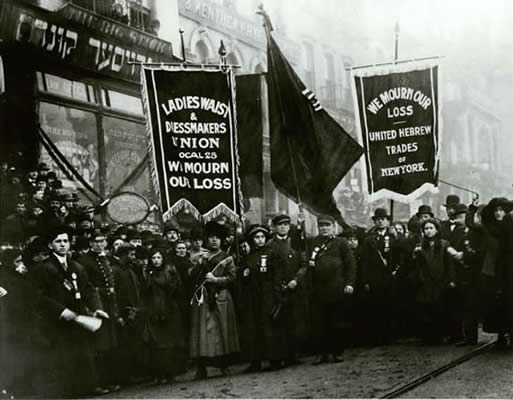
Numerous organizations including Public television have been commemorating the 100th anniversary of the tragic Triangle Shirtwaist factory fire in New York City on March 25, 1911 which resulted in the death of 146 young people. The shirtwaist sewing factory was located on the 9th floor of a building in lower Manhattan. It was a typical sweatshop with crowded and unhealthy working conditions. Numerous protests were held by the workers, mostly young women, from many of the sweatshops, trying to urge the government to take actions against owners that paid low wages for long hours of work. Government finally did act to provide for a safer working environment but only after the tragic fire at the Triangle Company killed so many. Fire fighters had limited ability to reach the top floors of the building, but more importantly, exit doors had been locked in an effort to limit stealing by employees. The owners of the factory were focused on making sure no material or sewing items were removed from the factory floor so only one exit that could be monitored was available. This decision proved to be fatal for the young women as they clamored to exit the building. Today we have agencies, such as the Department of Labor’s Office of Safety and Health, that enforce rules and regulations aimed at providing a healthy working environment. However, these agencies are often attacked for being too intrusive, and Congress has reduced funding for their operations. So what is the role of government…what are we willing to pay for safety?
The President Speaks to the Nation
The President will be going on the air on Monday at 7:30 to speak to us about our role in Libya. The President has been hailed by some as stepping up to help the rebels in Libya who want to get out from under a dictator’s rule, but he has also been criticized for not involving Congress in his decision. On Monday the President is expected to outline his goals for the US involvement and to assure the American people this effort will last only days, not months.
And Counting…
Only 6 days to go and not one winner! Put on your thinking caps!

No comments:
Post a Comment