Saturday, March 26, 2011

Battles Past and Present


This week we concluded our study of World War II battles by looking at the Pacific and European battlefronts. We watched a clip from Band of Brothers that included interviews with actual members of Easy Company. Their reflections add a sense of humanity to the study of D-Day. How does one prepare to jump out of airplanes that are under constant fire over enemy-held territory? After two years of training, these men knew their mission and were focused on wiping out the German batteries so the troops landing on the beaches of Normandy would have a chance of surviving to start the push to liberate Europe.


We also looked at a power point on the last days of Pacific fighting prior to dropping the bomb. President Truman took over after the death of FDR in April and only 4 months later he had the heavy decision as to how and when to use the bomb. On August 6 the first bomb was dropped on Hiroshima. The Japanese continued to fight so a second bomb was dropped on Nagasaki. The overwhelming destruction of the bombs convinced the Emperor that the time had come to surrender. Should the bomb have been used? Some historians argue that Japan was in its final weeks of having the ability to wage war and the US could have just waited for the surrender. Some historians argue that the Japanese would never give in and in order to save lives on both sides, the bomb must be used.


This week we also had an announced quiz on the experiences of different groups on the battlefront and the dropping of the bomb. Many of you earned high scores…congratulations. Close reading of the text, taking notes, and reviewing all help when it comes time to take a quiz.


We then started our discussion of life on the home front. We talked about how wars are financed: debt, taxes, reducing other expenditures, or printing more money. As you could see from our reading and the handouts, World War II was a massive effort and required the use of all four methods. Military outlays for WW II were almost 40% of the country’s GDP! Everyone at home was effected by the war…food was rationed, gas, oil and tires were limited, and collection drives for scrap metal and rubber were held regularly. There was something for everyone to do to help the cause. With a strong economy focused on producing military goods, workers had money in their pockets. While consumer goods were limited, money was spent on entertainment, such as attending weekly movies and purchasing paperback books known as “pocket” books. After looking at the changes on the home front, we compared changes today as our country is involved in conflicts in Iraq, Afghanistan and now Libya. You had the opportunity to think about our current home front and how our lives have changed or not changed due to these conflicts.


Finally, we did a practice World War II poster analysis to prepare for our task on Monday. We looked at the task rubric and a poster analysis sheet. We looked at two posters in our text and decided if they were propaganda or persuasion. We also looked at the elements of an effective poster…color, font, message and illustration. We used the famous “I want you” Uncle Sam poster as our final example. Please remember to bring in your rubric and poster analysis sheet as you may use both for the task on Monday. This technology task will go into your portfolio and you will also earn 20 points for in-class work. I know you can be successful if you follow the rubric.


For homework you had a worksheet that will help you organize information on the changing role of women during this time period. Woman had become Rosie the Riveter…they were building the planes, tanks and munitions while the men fought on the front lines. Women were also members of the different services but were prohibited from fighting on the front. Many women still lost their lives as they had dangerous jobs such as flying planes for target practice. These experiences gave women a new sense of independence but when the war was over the government urged women to return to the home. Servicemen wanted jobs and wanted life to be what it was before the war.


International Speakers


On Friday we had officers from Norway and Denmark share with us their countries’ histories and how they are structured. Both countries have small populations and abundant natural resources. The profits from these resources, such as oil and natural gas, have been put into a trust fund that pays for pensions for all over the age of 67. While both countries are noted for high taxes, citizens receive a wide range of benefits including one year paid maternity leave, all health care, and free higher education. Our next two speakers are from Chile and France and they will be with us on April 15. Both speakers on Friday commented that they appreciated the number of questions asked by the students. Great job!


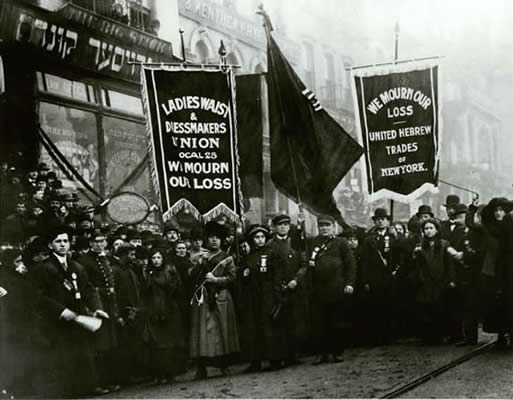
100th Anniversary of a tragedy that brought positive change


Numerous organizations including Public television have been commemorating the 100th anniversary of the tragic Triangle Shirtwaist factory fire in New York City on March 25, 1911 which resulted in the death of 146 young people. The shirtwaist sewing factory was located on the 9th floor of a building in lower Manhattan. It was a typical sweatshop with crowded and unhealthy working conditions. Numerous protests were held by the workers, mostly young women, from many of the sweatshops, trying to urge the government to take actions against owners that paid low wages for long hours of work. Government finally did act to provide for a safer working environment but only after the tragic fire at the Triangle Company killed so many. Fire fighters had limited ability to reach the top floors of the building, but more importantly, exit doors had been locked in an effort to limit stealing by employees. The owners of the factory were focused on making sure no material or sewing items were removed from the factory floor so only one exit that could be monitored was available. This decision proved to be fatal for the young women as they clamored to exit the building. Today we have agencies, such as the Department of Labor’s Office of Safety and Health, that enforce rules and regulations aimed at providing a healthy working environment. However, these agencies are often attacked for being too intrusive, and Congress has reduced funding for their operations. So what is the role of government…what are we willing to pay for safety?


The President Speaks to the Nation


The President will be going on the air on Monday at 7:30 to speak to us about our role in Libya. The President has been hailed by some as stepping up to help the rebels in Libya who want to get out from under a dictator’s rule, but he has also been criticized for not involving Congress in his decision. On Monday the President is expected to outline his goals for the US involvement and to assure the American people this effort will last only days, not months.


And Counting…


Only 6 days to go and not one winner! Put on your thinking caps!

Saturday, March 19, 2011

Overwhelming Events


Overwhelming world events dominated this week’s headlines: “Obama Threatens Military Action Against Qaddafi;” Stuck in Japan’s Danger Zone” and “Dozens Killed in Yemen.” Any of these events could bring major changes to our international community. The US, Britain, France and members of the Arab League are trying to fashion a united front against Qaddafi in an effort to help Libyan civilians being attacked by their own government. Government supporters fired on pro-democracy protesters Friday, killing at least 45 and wounding 200. Elsewhere, U.S. sympathy for pro-democracy demonstrators lies in direct conflict with long-term policies and alliances. Yemen’s weak government has received aid from the US in an effort to fight one of Al-Qaeda’s active branches, yet it responded brutally against Yemeni citizens seeking a less repressive government. The U.S. 5th Fleet is based in Bahrain and has good ties with its government, but that government has invited in troops from Saudi Arabia to help suppress demonstrations by its Shia majority, who feel oppressed by the ruling Sunnis. By now you have seen the numerous videos of Japan’s tsunami and the widespread devastation around Sendai. The nuclear power plants in this area have been severely compromised and radiation has been leaking for several days. Thousands are homeless or stuck without electricity or supplies, waiting to be rescued.

All these events demonstrate how much we are an international community…events in other countries affect all of us to varying degrees. The price of commodities such as oil and rice will rise as tensions continue. Parts for a variety of manufacturing lines throughout the world will be affected by the loss of plants in Japan. Will the nuclear fallout from this accident put a freeze on the building of new nuclear plants? Will energy become scarcer and more expensive in 2011? So much to think about…

World War II

This week we continued our study of World War II by looking at the Four Freedom illustrations of Norman Rockwell, works inspired by FDR’s speech to Congress. FDR wanted a world community that embraced freedom of speech, freedom of worship, freedom from want, and freedom from fear. These illustrations helped inspire people to buy over $130 million dollars’ worth of war bonds.

The war was not popular with some people, including one of America’s great heroes, Charles Lindbergh. You read primary sources from FDR, Lindbergh and Senator Taft that outlined the reasons some advocated involvement and some wanted neutrality. This is an important skill for you to develop…reading primary sources to understand both sides of an issue.

With the bombing of Pearl Harbor, the time for discussion was over and the US entered the conflict. We saw a power point that showed Japan’s aggression into neighboring countries and the U.S. island-hopping strategy to tighten the ring around Japan. The fighting was brutal with heavy losses on both sides.

You also read about the contributions different groups of Americans made to the battlefront. Your graphic organizer showed you how to divide the contributions made by men, women, African Americans, Mexican Americans, Native Americans and Japanese Americans. All of these groups made unique contributions to the war effort. Take a moment to look behind those contributions and consider the perspective each group had towards the war. As you read, African-Americans were limited in the roles they could play. Towards the end of the war, to beef up dwindling infantry units, they were allowed to train for the infantry. Native Americans were fighting for a country that did not allow them to vote. Japanese-Americans were fighting while their families at home were confined to internment camps. These groups that felt so much discrimination at home must have had great strength of character to see that even an imperfect America would be better than its enemies and that America itself would change over time.

We had the opportunity to think more deeply about the varied experiences of our soldiers during our accountable talk activity. We had three groups…one focused on the Pacific, one on Europe and one on the role of women. Your accountable talk activity on Friday gave you the opportunity to think more deeply about these events. Try to envision what it must have been like to be landing on the beaches of Normandy or fighting the tenacious Japanese in the Pacific or flying target airplanes...these people were everyday citizens...plumbers, electricians, factory workers, teachers and yet they were asked to defend our country in these faraway places under the most brutal of situations...you can see why they have been called “The Greatest Generation.”

Having student led discussions allows you time to develop your own thinking and to ask questions of your fellow students. Recently I was reading an article about successful interview techniques and the writer pointed out the importance of quality questioning. Doing accountable talk gives you that opportunity to ask questions…your questions…not questions from a text or teacher. Our discussion must still be rooted in the text, so make sure you use it to support your thinking. A special thanks to students who brought in outside information to enrich our understanding of the readings.

When you return next week we will talk about the reasons why the atomic bomb was used on Japan. You had some reading and questions to prepare for that discussion. I also have an interesting comparison to show you on the destruction of Hiroshima and the recent tsunami. It is an eerie comparison. I will also share with you photos from my trip to Hiroshima. For homework you are to do assignment number 7 on the syllabus…how the US shifted to wartime production.

International Speakers

Our next two speakers are from Norway and Denmark. They will be with us during Advisory on Friday March 25. You will be given a pass for the event. Please check in with your Advisory teacher and then come to room 212. What interesting questions will you have for our speakers?

Congratulations

So many good things happening at MHS this week…Islander girls’ basketball rules!!!! Who is Mr. MHS Middletown??? And good luck to our Academic Decathlon team!!

Counting

Only 13 days to go!!!

Saturday, March 12, 2011

And the Earth Shook


The devastation in Japan is overwhelming: nuclear power plants damaged, at least 1200 people killed, and billions of dollars of devastation. Japan is used to small tremors and has strict building codes that require construction to withstand possible earthquakes up to a 7.5 magnitude. This quake, at 8.9, is one of the strongest recorded and thus the devastation is extensive. Countries from around the world are sending aid…construction crews, dogs to locate trapped people, and medical personnel to tend to the injured.


Meanwhile, the rebels in Libya, the other country most in the news, remind me of our colonists who fought with limited training and weapons against a better-armed foe. Teenagers have joined the rebel forces in an effort to oust a dictatorial leader. It is sad to see the leader of Libya use aircraft and tanks against his own people. This is in stark contrast to the course of events in Tunisia and Egypt.


New Deal


This week we finished our study of the New Deal. We looked at the critics of the New Deal and discovered that people on the right thought the government programs were too extensive and intrusive and people should be able to take care of themselves. Critics from the left claimed FDR’s programs did not go far enough. Too many programs allowed women and minorities to fall through the cracks. FDR was also frustrated with the Supreme Court for ruling some of the programs unconstitutional. He tried to pack the court with younger members in an effort to keep his programs in place but this plan backfired. Everyone saw what FDR was trying to do and people would not go along with tampering with the system of checks and balances between our three branches of government.


This exercise of looking at both sides is helpful in understanding the criticism President Obama is receiving. Some people on the right, including those who represent the Tea Party, believe Obama’s programs are too expensive and intrusive and are fighting to eliminate them. On the left, many believe Obama is not doing enough to protect core programs such as Head Start and college aid. The President has said time and again he is trying to walk a middle ground that will allow for compromise. Time will tell if this strategy is successful. It seems the 2012 presidential race has already begun.


We also had a power point on the lasting legacy of the New Deal. Today we see government as part of the solution to many problems. This idea is rooted in the New Deal. Some of our most important government programs came from that era, such as Social Security, Federal Depositors Insurance and the Tennessee Valley Authority. And finally, some of our most important literature and expressions of creativity have come during difficult times. The Depression saw, for example, the publication of “The Grapes of Wrath” and “Gone with the Wind” and the creation of Walt Disney Studios. Radio became a unifying force; people used it for entertainment but also felt closer to their government with the FDR fireside chats. FDR was a master at using this medium to assure people he was on their side and was doing everything possible to bring relief, recovery and reform to our economic system.


For a final assessment, you wrote a letter to President Obama that gave you the opportunity to think about our current economic slowdown, reflect on lessons learned from the New Deal, and make a recommendation as to what further actions he could take to help our country. To help prepare for this assignment, you watched a video on how mail is handled in the White House and read an excerpt from “FDR: The First Hundred Days” by Anthony Badger that spoke about the importance of letters in shaping FDR’s view of his role as President. Your letters were collected on Friday. Next week we will put them in an envelope and send them to 1600 Pennsylvania Avenue.


Skills


In addition to learning new content we are learning new skills to help us be better learners. One skill we reviewed this week was paraphrasing, putting an author’s ideas into your own words. Often when you are asked to do a project, you may find information that is useful but putting it into your own words may be difficult. This can be particularly true if the author’s opinion agrees with your own; it is tempting simply to quote the author directly. You should try not to rely too much on direct quotes but instead put ideas into your own words, making sure you cite the source of the idea in a footnote. To help you with this skill, you got a handout from the OWL (Online Writing Lab) of Purdue University. This web site can be helpful as you hone your writing skills.


We also talked about how to use the text in an efficient manner to glean the main ideas from each section. Your text provides key concepts and terms at the start of each section. Take the time to review those ideas before and after you read. Take the bold headlines that divide the text and turn them into questions so you can test yourself after reading. Use the section review at the end of the text to test yourself for understanding. Yes, this does take some time but you will find it pays off in class discussions and quizzes. Preparing for any event, academic, athletic or social, takes time.


World War II


We started our new unit with a KWL. You quickly saw that our class knew a great deal about the war. When you have such a large and complicated event, it is useful to organize information into categories. We could use the tried and true “who, what, when, where and why” categories or we could use the two categories your text uses: the battles of WW II and life on the home front.
You read Prelude to War which gave you a quick overview of the events in Europe leading up to the conflict and ended with the bombing of Pearl Harbor, which brought the US directly into the war. The power point allowed us to review some of the key information in the text before you took the quiz.


To prepare you for our next class on neutrality versus involvement, we watched a brief clip on Charles Lindbergh. Lucky Lindy, as he was affectionately called, became a charismatic hero in 1927 as the first person to fly non-stop from NY to Paris. It is hard to find an example of people today who could be compared to Lindbergh. Alan Shepard, the first American in space, John Glenn, the first American to orbit the globe, and Neil Armstrong, the first man on the moon come to mind, but their efforts were part of America’s massive space program, where Lindbergh’s was largely a solo performance. We need to know who Lindbergh was so when we do the primary source reading, his statement opposing US involvement in the war, you will understand its importance and the influence it had.


For homework, you have a graphic organizer on Americans on the Battlefront. The reading in your text shows you how all different groups contributed to the war effort.


Interterms


We are at the half way mark for third quarter so interterms will be going out next week. To date you could have earned 130 points. On Tuesday we will update our status of assignment sheet. Please keep in mind that if you are absent excused, you have 5 days to make up the work. If you are allowed to revise, take that opportunity to improve your grade.


CNN: Restoring the American Dream


We watched a clip from CNN that linked our current economic difficulties, globalization and education. The interview with Fareed Zakaria showed you the interconnectedness of all we are trying to do in this class…you are part of a global economic community that is constantly changing and for you to be successful and thrive, you must be aware of this dynamic.


Go MHS Girls’ Basketball Team!!!


Only 19 days to go!

Saturday, March 5, 2011

A Roller Coaster Week


The stock market goes up 190 points one day then falls 165 points the next…what is an investor to do? The world is sending mixed messages. US unemployment goes down - a good sign - but the price of gasoline soars. Investors like stability, and while the US can offer peace and tranquility on the home front, our economy is still nervous about increases in commodity prices and expected sharp cuts in government jobs and services. The lessons we have learned by studying the Great Depression and the New Deal can be seen in our headlines. Should government try to pump money into the economy through public service jobs and rebuilding infrastructure? Should unemployment benefits be extended to the long term unemployed? How does the government provide basic services while trying to cut the deficit?


Tension and bloodshed have increased in Libya as the international community calls for Colonel Kaddafi to step aside. The revolutionary movement has proven to be well organized and tenacious and Colonel Kaddafi has demonstrated his brutality towards his own people with the use of deadly force. No country has come forward to offer the Colonel a safe haven so he may be forced to fight to the end.


Accountable Talk


This week we returned after our break to take up our accountable talk activity. You had two interesting readings as the basis of your discussion as well as the charts that showed income distribution within the United States. Accountable talk gives you the opportunity to initiate questions and topics. It allows you to explore the meaning of the articles as well as to make connections and ask questions. It is like a walk along a path that has several branches…which ones will you explore? So next time, take the opportunity to ask questions, make connections and try to find meaning in these articles.


Depression Assessment


This week I returned your writing assessments on the Great Depression. Some of you earned high grades by clearly writing about the causes and results of the Depression. Some of you were also given the opportunity to revise your work. Revision gives you time to go back and refresh your memory on some of the main concepts of this time period. Revisions were due the next day. If you are not going to revise, you must turn in your original work so you can earn some credit for the work you completed.


New Deal


You have a syllabus for the New Deal and you can see this is a quick unit. We will focus on the programs that FDR adopted. Historians have classified the programs as the three “R’s”: relief, recovery and reform.


Eleanor Roosevelt


Eleanor Roosevelt has been described as FDR’s legs. She travelled an estimated 50,000 miles per year gathering information on the challenges people were confronting. She reported back to FDR so that he could make decisions based on information from the perspective of the ordinary citizen. Mrs. Roosevelt was a champion of women’s rights and improved living conditions for minorities. Your project this week gave you the opportunity to learn more about Mrs. Roosevelt and to compare her activism with Mrs. Obama’s. Prior to Mrs. Roosevelt, First Ladies acted as the country’s official hostess, but Mrs. Roosevelt wanted a more active role in her husband’s administration. Many historians have compared Eleanor Roosevelt and Hillary Clinton, another First Lady who took an active role in policy decisions during her husband’s administration. Mrs. Clinton went on to become a Senator from New York, ran for President in 2008 and now serves as Secretary of State.


Gail Collins, an opinion writer for the New York Times, had an article in Thursday’s paper that referenced Mrs. Roosevelt and the study she sponsored on the status of women. We had the opportunity in class to read that piece. You might be interested to note that the article was the second most emailed article from the paper that day. So you were reading the same article that millions of people across the world were reading.


We will study more about the Women’s Movement when we come to the 1960’s and the push for the Equal Rights Amendment.


New Deal Charts


We finished completing our New Deal charts by working with a partner and using multiple sources. It seemed as if FDR and his administration had a program for everyone: bankers, workers, young people, Native Americans and farmers. The government was trying a lot of different approaches to get the economy moving again.


Critics of the New Deal


Not everyone supported the New Deal. Your homework focuses on the critics from the left, the right and the Supreme Court. Your worksheet has two sides so make sure to answer the questions on both sides using your text.


I want to be a Millionaire


Your handout showed that if you save $20 a week and put it in a bank or other secure investment, you will be a millionaire by the time you are 65. The power of saving early and often and allowing compounding to add to your nest egg is the key to a happy accumulation of wealth. For more information on how to save and invest check out http://www.fool.com/.


International Speaker Series


Once again we heard two fascinating presentations on Friday. Officers from Brazil and Argentina shared with us their countries’ history and culture. I was impressed by their countries’ ability to become energy independent. Can you imagine if our country produced all of its own energy needs? Thank you to the many students who asked interesting questions.
Our next speakers will be March 25 from Norway and Denmark. On April 15 we will hear from France and Chile. Our series ends with a presentation on the United Kingdom.


Was that OUR Mr. Young???


Oh my gosh…was that our Mr. Young on the dance floor? Did someone say it is one of the top videos on You Tube?


The Countdown has begun…only 27 days to go…..