This week our community, state and national governments were focused on budgets. How does a government raise funds to pay for services and what services should be provided? These are the questions that all generations grapple with. Many political pundits and individuals have tried to lay blame on different segments of our society that have caused us to have such huge deficits… labor unions, bankers, war hawks, or special interest groups. When times get particularly difficult it is natural to look to some group to blame but in fact we are all at fault. Fiscal planning and prudence must start with each of us individually before we can expect our governments to act in responsible ways. It was interesting to see articles in The New York Times and Providence Journal talking about the new segment on Sesame Street that will focus on money management. The videos are called “For me, for you, for later” and will be a series of lessons on earning, spending and savings.
 No one likes paying taxes, but taxes are what we pay in order to have an organized, safe and productive community. Who should pay these taxes, how much they should pay, and how the funds should be spent are subjects of a never-ending debate.
As a member of a union, I was especially pleased to see the article on the front page of the Friday Newport Daily News entitled “Expert: Wall Street to blame for bad economy, not unions.” Scott Molloy, a professor from URI, spoke to a group in Portsmouth about the current economic crisis and how irresponsible banking practices coupled with federal deregulation led to our economic turn down. The most discouraging part of the article was the reference to the lack of change on Wall Street. Lessons have not been learned that would change their behavior as no bankers have been held accountable for their lending practices. Astronomical salaries and bonuses are once again the norm.
Cold War Wrap Up
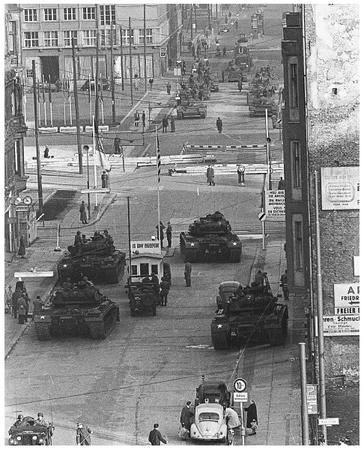
This week we finished our study of the Cold War by watching “Duck and Cover” and two clips about the Berlin Wall and the Cuban Missile Crisis. I urge you to talk with family members about this time period and the unique role Newport played during the Cuban Missile Crisis, when the city was still home port for the Atlantic Fleet. Oral history makes our past come alive and gives major events a more personal meaning. As we enter our last quarter, you will be interviewing someone who has lived through events we are talking about so you can get a better understanding of how they affect all of us. I can guarantee you that in years to come, when your own children are taking American History, they will ask you about what is was like during the economic slowdown of 2010 or when President Obama was elected. You are living history and you will be the primary sources of the future. Stay alert!
We finished our unit with a look at the controversy surrounding the Vietnam War. By using music, photos, and documents you could see why the country was divided over this war. Where is Vietnam…why are we there…who is the enemy? After completing your guiding questions, you worked with your group to come up with a thesis. This is what it means to be an historian…asking questions, reviewing a variety of sources, and then coming up with a thesis.
Many of you did a great job on your final assessment. You had multiple choice questions and a writing activity that focused on your vocabulary list.
World War II Poster Task
Congratulations to the many students who met standard on the portfolio technology task. You earned class credit as well as the opportunity to put it in your graduation portfolio. The task was written so you could earn technology credit.
Three Down and One to Go
We finished our third quarter this week. We want to thank Mr. Young for all he did to make this quarter such a success. He will be with us for one more week and then it is time for him to take his finals and walk the stage. I think all of us who have had the pleasure of working with Mr. Young have learned a great deal. Make sure you take the time to say thank you.
Civil Rights Unit
Our next unit of study will be the Civil Rights Movement. While most historians focus on events that deal with African American efforts to gain political and economic rights long denied them, our concept of civil rights for all groups is constantly expanding. We will start with the efforts by such key leaders as Martin Luther King, the Little Rock Nine, Macolm X and others to bring African Americans into parity with whites. But the success of their efforts also led women and other minority groups to fight for their rights. In today’s paper, there was an interesting article on California’s efforts to include the study of Gay History in the high school curriculum as a way to further broaden the ideas of civil rights for all Americans. This is a direct link to our Day of Silence on Friday.
If you are looking for a good book to read about this time period, I would recommend the best seller “The Help” by Kathryn Stockett. It tells the story of several black maids and their relationship with their white employers in the 1960’s in Mississippi. It is a moving and sometimes disturbing account of how racial divides were viewed very differently by whites and blacks. This book has become so popular it has appeared on the best seller list for hardbacks for over 100 weeks and is now on the ebook best seller list.
International Speakers
Our speakers series continued with week with officers from France and Chile. Their presentations gave us background on the geoepgraphy and the history of their countries and some of the problems they are facing. Our last speaker is May 13 and he will be from The United Kingdon.
Time for some R and R
So now we are on break…no homework…but I know you will keep up with the news. This blogger will be off next weekend so no posting.